
|
The UKK walk
test (UKK are the initials for Urho Kaleka Kekkonen, founder of the UKK
Institute in Tampere/Finland) makes it possible under certain assumptions
to determine the approximately max. cardio respiratory efficiency (VO2 max)
and therefore the physical condition of the subject. The
UKK-walk test is perfectly suitable as a fitness check for fitness clubs
or for athletes at schools for example.
On the basis
of this result a Fitness-Index is calculated with the help of a complex
formula taking age, height, weight, test duration and Heart-Rate into
consideration, which tells us whether the physical condition of the
subject is above or below average. The value of 100 as the average serves
as the base. If somebody's index-value is 90 then his physical condition
is slightly below average. An index-value of 110 on the other hand would
be above average.
The
test explains itself by its name. In order to perform the test after
having done some warming up and some stretching walk for 2 km as fast as
possible (Do Not run!). It is important to keep the walking speed as high
as is needed for the subject to achieve 80% of their max. Heart-Rate ( 220
– age). The test duration and heart-rate are measured immediately after
finishing the 2 km distance.
As
soon as the 2 km distance has been absolved the speed gets reduced to half
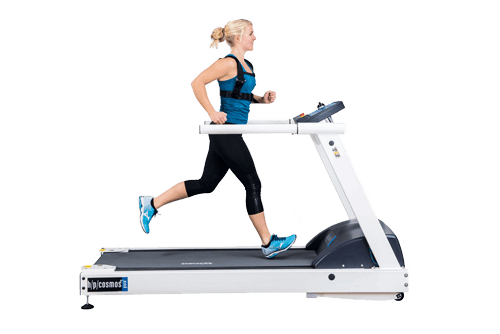
the speed at the end of the test (2000 m). The Running-Machine operates as
described under point "Manual-Mode" (the UP/DOWN-keys are in
operation again) with one exception:
|
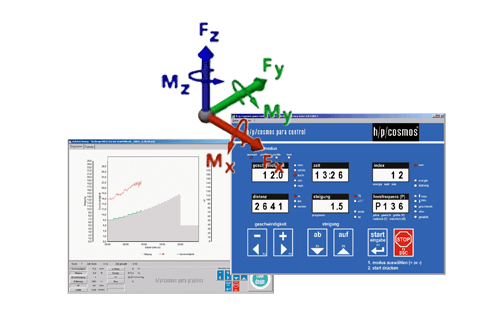
The display INDEX instead of
indicating the wattage and energy consumption, indicates the test result (calculation
following). The LED INDEX is flashing (top right hand side). The
test-result is the index-value which is calculated as follows (according
to sex):
Men
INDEX
VALUE = 420 + A x 0,2
–
(T x 0.19338 + HR x
0.56 + [W : (H2) x
2.6])
Women
INDEX
VALUE = 304 + A x 0.4
–
(T x 0.1417 + HR x
0.32 + [W : (H2) x
1.1])
UKK walk
test evaluation scale
A
= Age in years
T
= Time = neede for 2 km in seconds
HR
= HeartRate = average heart rate during the test in bpm
W
= Weight in kg
H
= Height in cm
Example
Male,
Age:
50 years
Weight: 105 kg / Height: 188 cm
Duration of test: 17:34 =
1054 seconds
Heart
rate at m: 500 = 158, 1000 = 156,
1500 = 160 and
2000 = 155
Average
(158 + 156 + 160 + 155) : 4 = 157 bpm
|
Index
value
420
+ 50 x 0.2 – (1054 x 0.19338 + 157 x 0.56
+
(105 : (1,882) x 2.6))
=
420
+
10 - (203.8 + 87.9 + 29.7 x 2.6)
= 430
–
368,9
= 61
An
index-value of less than 70 is a result quite below average (average=100).
Conclusion: Our subject is in need of some indurance training.
Basically
the test is suitable for all physically healthy persons between the age of
20 and 65. The results will be less accurate with people with overweight.
Athletes usually do not reach the required heart-rate when performing the
test. The results will also be less accurate with elderly people.
First
it has to be mentioned that the UKK-Test has not been designed for
individual tests but for a larger amount of subjects. i.e. testing of a
crowd of people at the same time by sending them off in 1/2 minute
intervals on the 2 km-distance track. Therefore originally the UKK-Test
has not been designed as a typical test for the running machine.
Advantages
of performing the ukk walk-test on the running-machine: Being able to
measure the precise time and distance of the test (it is exactly 2 km) and
Heart-Rate control during the test. Direct
test documentation via the printer interface.
See
a walking
test video and
10
people walking on h/p/cosmos mercury in Seoul / Korea.
|